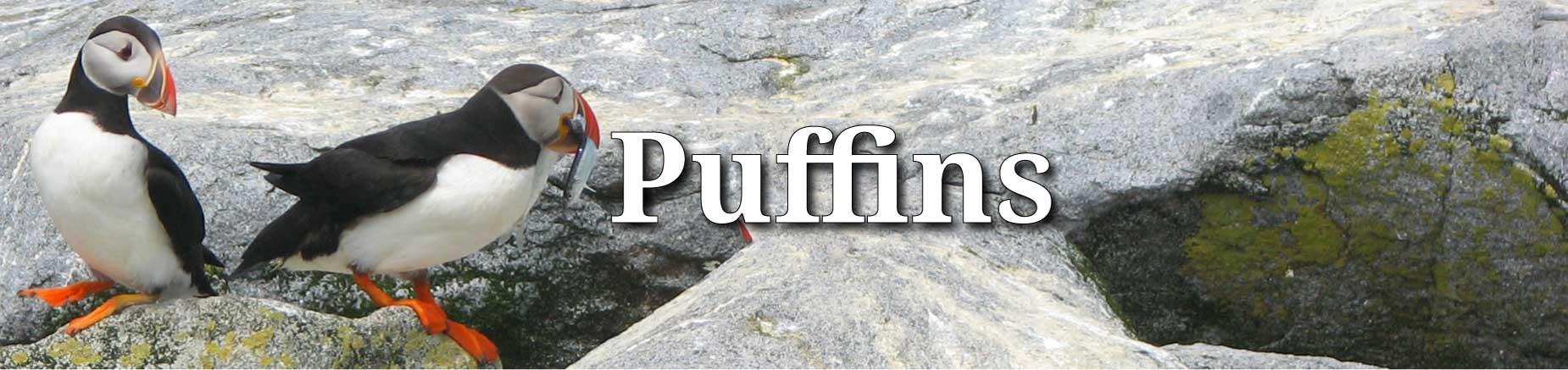
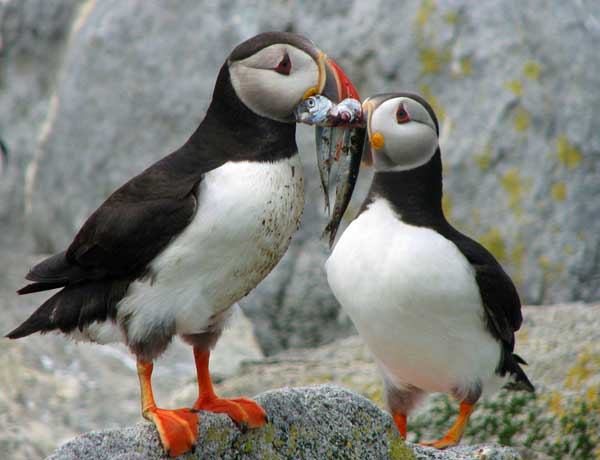
Atlantic Puffins come ashore to breed in late April and begin returning to the sea in August. Some linger into September, but the fruitful season for visitation is only about a dozen weeks long. Tours begin at the end of May and usually finish for the season in mid August.
Puffins are truly pelagic. When fledged, young puffins will not return to land until they are mature enough to breed, about five years later. Once they leave their islands, all the puffins disperse across the ocean and are seldom seen, even from boats. Puffins are rarely seen from the mainland. Puffins are abundant from Newfoundland to Iceland to Scotland, spanning the cold regions of the North Atlantic. Maine is historically the southern edge of their breeding range.
Puffins are members of the alcidae family. Other alcids on the east coast include Razorbills, Black Guillemots, Common Murres, Thick-billed Murres, and Dovekies. The latter two species do not nest in Maine but are seen in Maine waters in winter. Razorbills nest on four of the puffin islands,
as well as a couple of other islands in downeast Maine. Common Murres frequent puffin colonies and nesting may occur on the northernmost of
the five puffin colonies. Black Guillemots are the only alcid to nest along mainland cliffs and are readily seen from shore along the entire
coastline.
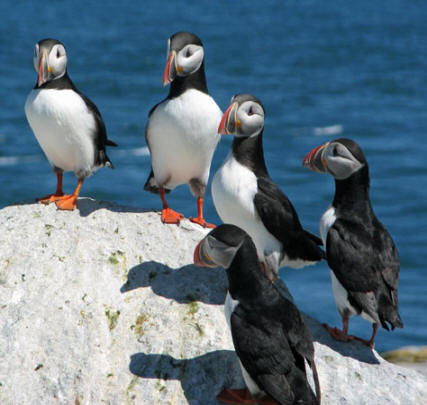
History has not been kind to Maine's puffins. A century ago, they were nearly eliminated from the state as the colorful birds were prized for their feathers, and their eggs were gathered for the dinner table. In 1973, the Puffin Project was established in an attempt to bring them back to their historical range. Although the project has been a resounding success, major threats still remain. Open air dumps in the 1900s caused an overpopulation of gulls, which competed for space on nesting islands, and they often preyed upon puffin chicks. Gulls remain a significant obstacle. Food resources are also in great peril. Overfishing and the elimination of spawning habitat has greatly diminished herring and other small fish species relied upon by the puffins. Climate change is warming the Gulf of Maine rapidly.

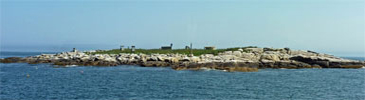
Eastern Egg Rock is a 7-acre island located six miles from New Harbor. It is owned by the state and managed by The Puffin Project. This is the world's first re-established seabird colony. Techniques learned here are now being employed throughout the world.
This is one of the most-visited puffin islands due to its southern location and nearness to shore. Because boats from several parts of the Midcoast
area make trips to the island, there are more departure options. The island is less exposed to challenging seas and this can be a good choice for those prone to seasickness. Also, the boats are large enough to handle rough water, reducing the possibility of getting splashed on windy days.
Common, Arctic, and Roseate Tern colonies are established on the island and it is one of the most reliable places to see Roseate Terns in Maine. While Common and Arctic Terns nest in bare scrapes, Roseate Terns prefer vegetative cover. As a result, they are usually easy to see in their favorite
spot at one end of the island.
On two of the tour boats shown below, the Hardy Boat and Capn' Fish, educators from National Audubon's Project Puffin Seabird Restoration Program) provide the narration. These are the only tours in the state narrated by the folks who have actually done the puffin restoration. The Hardy Boat visits Eastern Egg Rock every day during puffin season, departing from New Harbor. Call 1-800-2-puffin.
Cap'n Fish circles the island up to four times a week from Boothbay Harbor. Call 800-633-0860.
The Monhegan Boat Line in Port Clyde visits the island daily and four evenings a week during the puffin season, mid-June through August. Call 207-372-8848.
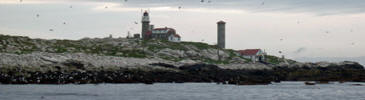
Matinicus Rock is the most remote puffin colony, located 23 miles southeast of Rockland. Due to its remoteness, it was the last island to retain nesting puffins into the early 20th century.
In 1901, the lightkeepers were hired by National Audubon to act as wardens and protect the remnant population. Its 22 acres supports many nesting seabirds and in recent years the island hosted the only known nesting site for Manx Shearwater in the United States. Besides Atlantic Puffins,
Razorbills nest in good numbers and Black Guillemots are plentiful. Several thousand Common and Arctic Terns nest on the island and Roseate Terns are occasional nesters.
The island is owned by the U.S. Fish & Wildlife Service and is part of the Maine Coastal Islands National Wildlife Refuge. There are no regularly scheduled commercial trips. Charter trips are available from Matinicus Excursions . Call 207-691-9030.
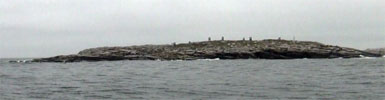
Seal Island is not to be confused with Machias Seal Island, which is much farther north. At 65 acres, it is three
times the size of Matinicus Rock and lies 22 miles off the mainland and about 8 miles northeast of Matinicus Rock.
Puffins were hunted for their meat and feathers through the 19th century and egg-gatherers raided most of Maine's islands. What seabirds weren't
extirpated by the middle of the 20th century were quickly finished off by the U.S. military which used the island for bombing practice
until the 1960s. Seabird restoration began in 1984 and the success has been astounding. Besides the abundant Puffins and Razorbills,
Seal Island is home to a significant colony of breeding Great Cormorants, making this island the top preference for those who want to see
both Atlantic Puffins and Great Cormorants. Black Guillemots are abundant on the way to the island, and the trip passes through waters that are good for pelagic species.
Scheduled trips to the island begin during the Wings, Waves, and Woods birding festival over the third weekend of May. All trips leave from Stonington and generally pass Isle au Haut on the way out to sea, making this a particularly scenic puffin trip.
The Isle au Haut Ferry makes Sunday trips to the island every summer, and is one of the best trips in Maine.
Swans Island Charter Tours offers a variety of local adventures as small private charters (6 passanger maximum), including puffin trips to Seal Island.
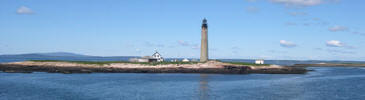
Petit Manan Island is a 16-acre island covered in birds. It supports a large population of Laughing Gulls and Common Terns, almost as many Arctic Terns, and several pairs of Roseate Terns. Many pairs of Razorbills visit the island, and actual nesting began in 2007. Leach's Storm-petrels, Black Guillemots, and Common Eiders also nest on the island. The island and the nearby Petit Manan peninsula are part of the Maine
Coastal Islands National Wildlife Refuge and is under the supervision of the U.S. Fish & Wildlife Service. The 119 foot lighthouse
is second only to the Boon Island lighthouse (133 feet) in southern Maine as the tallest in the state.
The island is a good example of the sometimes unbalanced competition that occurs on nesting islands. Over 1500 pairs of terns were documented until 1971 when the lighthouse became automated and lightkeepers ceased to discourage gulls from overrunning the terns. By 1983, all terns were gone.
Restoration began in 1984 and today the diversity of nesting seabirds is much improved. This is such an important colonial nesting colony that
cooperative research is conducted all summer by the USFWS, the Maine Department of Inland Fisheries and Wildlife, the College of the
Atlantic, the University of Maine, and the University of New Brunswick.
Bar Harbor Whale Watch makes daily morning trips to the island before heading out to the whaling grounds. This is an
ideal trip to take for those who wish to combine puffin-watching with pelagic birding. The boat is large, fast, and stable. Call 207-288-2386.
Acadian Boat Tours offers its Puffins/Lighthouses & Seabirds tours between mid May and mid August on its new boat, the Eden Star. With upper and lower decks, indoor and outdoor seating, a small galley, clean restrooms and FREE onsite parking.Trips leave daily at 9:30 a.m. and run approximately 3.5 hours with full narration from an experienced naturalist! Call 207-801-2300.
Acadia Puffin Cruise visits the island from Steuben, which makes it exceptionally convenient for travelers on the Schoodic Peninsula side of Acadia National Park. Voyages start very close to Petit Manan, and the boat gets nearer the puffins than some. The short trip is helpful for anyone uncomfortable on the water, and it allows the boat to offer up to three trips per day. Call: 207-598-7900 or 207-598-7905.
Robertson Sea Tours visits the island on board the Kandi Leigh from its headquarters in Milbridge. The shallow draft of the boat allows it to get in closer to shore than the larger boats from Bar Harbor. Call 207-483-6110.
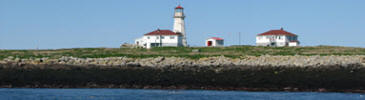
Machias Seal Island is the granddaddy of puffin islands. Thousands of nesting Atlantic Puffins populate the 20-acre island, accompanied by hundreds of Razorbills and Common Murres. Large colonies of Common and Arctic Terns have historically nested here, but recent nesting success has diminished, possibly due to food shortages or gull predation.
This is the only puffin colony that allows visitors to land. A very limited number of people each day are allowed to go ashore and watch puffins from blinds, often within arm's length. The puffins are accustomed to the visits and readily approach the blinds so long as they are not disturbed.
Visitors are shuttled ashore by small skiff and climbing onto the wet walkway when there is wave action can be tricky. When winds are from the wrong direction, landings are impossible and the captains will circle the island instead, which still provides exceptional views of all the alcids ashore. Foggy days are not discouraging because fog often keeps the birds closer to the island and numbers can be particularly exciting.
Only two boats land passengers, one each from the U.S. and Canada. Bold Coast Charters operates out of Cutler, Maine, and visits the island daily. Call 207-259-4484.
The Wilcox family has provided trips from Grand Manan, New Brunswick, Monday-Saturday since 1969. See
Seawatch Tours or call 877-662-8552.
The island is an historic artifact, as ownership has remained in dispute between the United States and Great Britain (later Canada) since the American Revolution. The Treaty of Paris settled most of the boundary between the nations, but agreement on several islands and waters was not
reached until the Treaty of Ghent following the War of 1812. However, that treaty failed to mention Machias Seal Island. Canada maintains
and staffs the lighthouse that was built by the British long ago, but this possession is not recognized by the United States as legitimizing
Canada's claim to the island.
In truth, stewardship of the island has been cordial and passports are not needed to visit the island. Lobster-fishing rights around the island are the main cause of tension, and disputes over this "gray zone" erupt periodically.